Dieng Temple At The Clear Air Of Dieng Plateau

Dieng is a plateau located about 26 kilometers north of Wonosobo, Central Java. Extent of Dieng approximately 619.846 hectares. Dieng's area surrounded by several mountain (mountain clusters). The mountains include: Sumbing, Sindoro, Perahu, Rogojembangan and Bismo. The name of Dieng, comes from the word Di-Hyang, which means "dwells place of the gods". At altitude about 2050 meters from sea level, Dieng plateau measuring about 14,000 square meters and formed by non active volcano. The shape of craters visible from the plain located in the center surrounded by hills. Traces of other craters, Sikidang for example, is sometimes still show volcanic activity. In addition, there are also volcanic activity in the form of gas / geothermal steam is channeled through a pipe with a diameter large enough. Geothermal gases were used as power plants. One of the interesting things are on the plateau is the ancestral form of several temples (complex enshrinement).
Dieng temples complex built in Hindu era, because the area is commonly found enshrinement relics statues of Lord Shiva, Vishnu, Agastya, Ganesha and other which characterized by the Hindu religion. However, local communities named temples by purwa puppet characters in the Mahabharata, for example Arjuna temple, Gatotkaca temple, Dwarawati temple, Bhima temple, Semar temple, Sembadra temple, Srikandi temple and Puntadewa temple. Name for these temples there are no relation to the function of the building and estimated temples name are given after the temple was abandoned or not used anymore. Until now has not known for certain who built it. Based on one of the 12 existing inscriptions, the complex is made enshrinement 731 (Saka) or 809 AD. So, in the early 9th century.
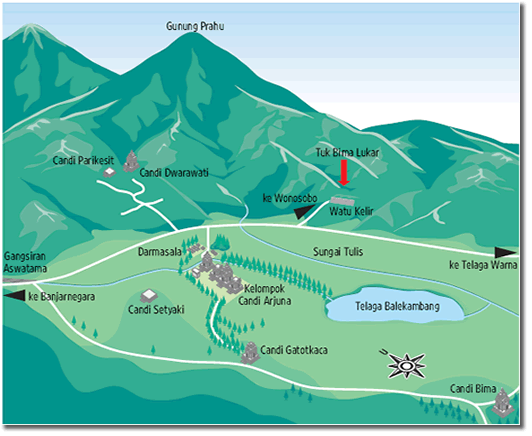
Complex enshrinement in the Dieng plateau can be divided into several groups, namely Arjuna Temple, Gatotkaca Temple, Dwarawati Temple and Bhima Temple. Each group consists of several temples that are also named by characters in the Mahabharata story.
Dwarawati temples complex
Dwarawati temples complex is located at the north of the temples on the Dieng plateau is established at the Perahu Mount. Previously this complex consists of two temples, there are Dwarawati temple (East) and Parikesit temple (West). However, currently only Dwarawati temple still standing. Dwarawati temple facing west with a rectangular shape, measuring 5 meters long, 4 meters wide, and 6 meters high. In each of the outer and inner walls of the temple there are niches where the statues that have been empty, except for a statue base in the chambers of the temple (dhâtu garbha). Meanwhile, the roof of the temple decorated with small towers and decorated with paintings. Roof forms and ornaments is influence of South India.
Petirtaan Bimo Lukar
Pertirtaan is water pond with clear-eyed, heavy water flow and measuring 5 meters x 2.5 meters x 1 meter. The building consists of a stone structure adorned with reliefs. The water is channeled through a few showers.
Arjuna temples complex
Arjuna temples complex is the largest. If someone says Dieng temples, usually mentioned is a group of Arjuna temple, when in fact there are many other groups. The group that extends from north to south is composed of two rows of the temple, which is a row of the east and west.
East rows facing to west and consists of several buildings of the temple, namely: Arjuna-Srikandi Temple, Puntadewa Temple, and Sembadra Temple. Meanwhile, the west line of only one temple that still stands, Semar Temple facing to Arjuna Temple. Unlike Dwarawati temples complex, which forms a rectangle, Arjuna temples complex is square, just at the front of the entrance there is a booth that jutted forward. On the walls there are niches and ornaments. In the front adorned with kala-makara. The roof is rich in decoration. Unfortunately, most of the temples in the complex has been damaged and some are just the foundations. Actually, about 200 yards to the southwest of the Arjuna temples complex are the remains of buildings known as the Setyaki, Petruk, Antareja, Nala Gareng, Nakula and Sadewa Temple, but it was difficult to identify because only a foundation.
Ghatotkacha temples complex
Ghatotkacha Temples higher than Arjuna Temple, Located on west of Bale Kambang lake and Panggonan hillside. Gatotkaca temple facing to the west with square shape 4.5 meters x 4.5 meters.
Bima temples complex
Bima temples complex is now only one temple and located at the southernmost end of the row, facing east. The Batur sized 6 meters x 6 meters, with octagonal foundation, 8 meters high. Compared to other temples, Bhima Temple is most intact. The roof was decorated and comprises three levels of boundaries. All temple's shape like Sikhara at North India, only the tower decorations and recesses that shows a horseshoe-shaped influence of South India.

Dieng temples complex built in Hindu era, because the area is commonly found enshrinement relics statues of Lord Shiva, Vishnu, Agastya, Ganesha and other which characterized by the Hindu religion. However, local communities named temples by purwa puppet characters in the Mahabharata, for example Arjuna temple, Gatotkaca temple, Dwarawati temple, Bhima temple, Semar temple, Sembadra temple, Srikandi temple and Puntadewa temple. Name for these temples there are no relation to the function of the building and estimated temples name are given after the temple was abandoned or not used anymore. Until now has not known for certain who built it. Based on one of the 12 existing inscriptions, the complex is made enshrinement 731 (Saka) or 809 AD. So, in the early 9th century.
Complex enshrinement in the Dieng plateau can be divided into several groups, namely Arjuna Temple, Gatotkaca Temple, Dwarawati Temple and Bhima Temple. Each group consists of several temples that are also named by characters in the Mahabharata story.
Dwarawati temples complex
Dwarawati temples complex is located at the north of the temples on the Dieng plateau is established at the Perahu Mount. Previously this complex consists of two temples, there are Dwarawati temple (East) and Parikesit temple (West). However, currently only Dwarawati temple still standing. Dwarawati temple facing west with a rectangular shape, measuring 5 meters long, 4 meters wide, and 6 meters high. In each of the outer and inner walls of the temple there are niches where the statues that have been empty, except for a statue base in the chambers of the temple (dhâtu garbha). Meanwhile, the roof of the temple decorated with small towers and decorated with paintings. Roof forms and ornaments is influence of South India.
Petirtaan Bimo Lukar
Pertirtaan is water pond with clear-eyed, heavy water flow and measuring 5 meters x 2.5 meters x 1 meter. The building consists of a stone structure adorned with reliefs. The water is channeled through a few showers.
Arjuna temples complex

Arjuna temples complex is the largest. If someone says Dieng temples, usually mentioned is a group of Arjuna temple, when in fact there are many other groups. The group that extends from north to south is composed of two rows of the temple, which is a row of the east and west.
East rows facing to west and consists of several buildings of the temple, namely: Arjuna-Srikandi Temple, Puntadewa Temple, and Sembadra Temple. Meanwhile, the west line of only one temple that still stands, Semar Temple facing to Arjuna Temple. Unlike Dwarawati temples complex, which forms a rectangle, Arjuna temples complex is square, just at the front of the entrance there is a booth that jutted forward. On the walls there are niches and ornaments. In the front adorned with kala-makara. The roof is rich in decoration. Unfortunately, most of the temples in the complex has been damaged and some are just the foundations. Actually, about 200 yards to the southwest of the Arjuna temples complex are the remains of buildings known as the Setyaki, Petruk, Antareja, Nala Gareng, Nakula and Sadewa Temple, but it was difficult to identify because only a foundation.
Ghatotkacha temples complex
Ghatotkacha Temples higher than Arjuna Temple, Located on west of Bale Kambang lake and Panggonan hillside. Gatotkaca temple facing to the west with square shape 4.5 meters x 4.5 meters.
Bima temples complex
Bima temples complex is now only one temple and located at the southernmost end of the row, facing east. The Batur sized 6 meters x 6 meters, with octagonal foundation, 8 meters high. Compared to other temples, Bhima Temple is most intact. The roof was decorated and comprises three levels of boundaries. All temple's shape like Sikhara at North India, only the tower decorations and recesses that shows a horseshoe-shaped influence of South India.